REVIEW · GUANGZHOU
UNESCO Watchtowers World Heritage Ancient Villages Private Tour
Book on Viator →Operated by Guangzhou Local Tours · Bookable on Viator
Watchtowers built like fortresses. That’s the fun hook of this Kaiping day trip, where overseas Chinese ambition shows up in Diaolou stone towers and village streets. You’ll head about 2 hours from Guangzhou into farmland country, stopping at UNESCO-linked watchtower clusters and classic local sights.
What I like most is the contrast: Diaolou villages with fortress-style architecture, then quiet garden and old-town streets that feel a world away from the city. Second, the trip is genuinely easy to manage because you get a local English-speaking guide, plus hotel pickup and a private air-con car.
One thing to plan for: admission fees (and lunch) aren’t included for you or the guide. Budget extra so you’re not scrambling later.
4-6 key highlights you’ll care about
- Private car with hotel pickup in downtown Guangzhou, so you’re not piecing together transport
- Zili Village Diaolou cluster plus the Watchtower Group tied to Qing-era village founding
- Li Garden (Kaiping Garden), a garden designed by Xie Weili, a US-based Chinese, with literary inspiration
- Chikan Movie Town for Qilou streets and a mix of Cantonese and Western-style buildings
- A countryside route that passes farmland, livestock sheds, and fishponds, so the day feels like more than just “ticket stops”
In This Review
- From Guangzhou to UNESCO Diaolou Towers: What This Trip Gets Right
- Private Car, English Guide, and Timing That Won’t Stress You Out
- Zili Village Diaolou Cluster: Fortress Towers and Village Streets in One Stop
- Zili Village Watchtower Group: Qing-Dynasty Names and the Fang Villages
- Jinjiangli Village: Farmland Paths, Water, and Quiet Countryside Details
- Kaiping Garden (Li Garden): Xie Weili’s Garden Ideas and the Dream of the Red Chamber
- Majianglong Towers Group: More Watchtowers by the Tanjiang River
- Chikan Movie Town: Qilou Streets With Cantonese and Western Influences
- Value and Price: Is $255 Per Person Fair for a Private UNESCO Day?
- Who Should Book This UNESCO Watchtower Day Trip?
- FAQ
- How long is the UNESCO Watchtowers and Ancient Villages private tour?
- Where does the tour start and is pickup included?
- Is this a private tour or shared with other groups?
- What’s included in the price, and what’s not?
- Which UNESCO-related places do we visit on the day?
- Do we get tickets on our phone?
- Is the booking refundable if plans change?
From Guangzhou to UNESCO Diaolou Towers: What This Trip Gets Right
Kaiping’s Diaolou are hard to forget. These watchtower houses look like they were built to defend something—because in a way, they were. In the late 1800s into the early 1900s, overseas Chinese sent money and ideas home, and the result was a cluster of multi-story towers and fortress-like residences in rural villages.
This tour is built around that idea: not just seeing one isolated tower, but understanding how the towers fit into village life. You’ll move through watchtower clusters, then soften the pace with garden design and old-town streets.
And yes, the setting matters. The drive from Guangzhou is long enough to feel like you’ve changed worlds, but short enough that the whole day still feels doable.
Private Car, English Guide, and Timing That Won’t Stress You Out

This is a private day trip with a professional driver and a full-escort local English-speaking guide. That matters in Kaiping because you’re dealing with rural roads and site-to-site transitions that are easier with someone who knows where to go.
Typical time on the clock is 5 to 11 hours, so your schedule can flex depending on the day and how the itinerary runs. One traveler said the whole thing felt like about 8 hours total—useful as a reality check if you’re trying to plan dinner back in Guangzhou.
On the way, you’ll pass farmland, livestock sheds, and fishponds. That sounds simple, but it’s part of the value. You’re not stuck staring out a car window for hours; the scenery reinforces why Kaiping’s heritage lives in these countryside villages, not just museum rooms.
A small practical point: since admissions are not included, make room in your day for ticket lines, even if you have a guide to help you keep things organized.
You can also read our reviews of more private tours in Guangzhou

Zili Village Diaolou Cluster: Fortress Towers and Village Streets in One Stop
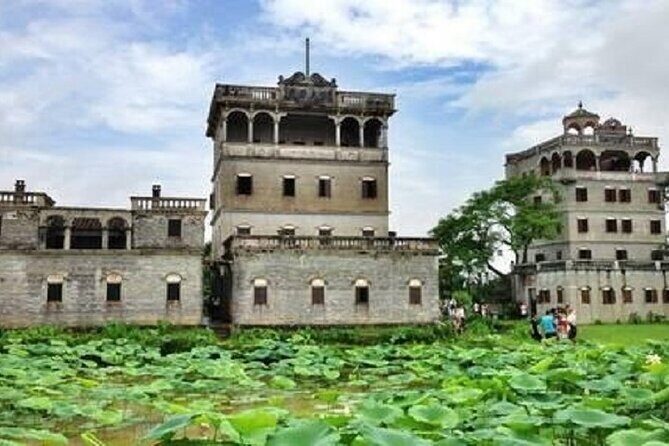
Your first major architecture hit is in the Kaiping area’s Zili Village Diaolou cluster. The core appeal here is that you’re looking at watchtower houses that resemble fortresses—built in the 1900s by overseas Chinese migrant workers and their families.
What makes this stop more than a photo-op is the way the towers relate to their surroundings. In rural village clusters, these weren’t just decorative towers. They create a skyline and a sense of layered defense, with multiple levels rising above farmland paths.
What to watch for
- Notice how thick, sturdy tower forms sit above the village layout
- Look for how the cluster arrangement gives different views depending on where you stand
- Pay attention to how many towers sit close together, not spread out like isolated landmarks
Possible drawback
If you’re expecting a lot of indoor exhibits, you might find this stop is more about exterior architecture and walking between towers than museum-style storytelling. That’s not bad—just set expectations.
Zili Village Watchtower Group: Qing-Dynasty Names and the Fang Villages
Next comes the Watchtower Group of Zili Village, which has a strong historical anchor. It traces back to the 17th year of Daoguang’s reign in the Qing Dynasty, which is 1837. The group includes the villages of Anheli, He’anli, and Yong’anli, described as unincorporated villages with the surname Fang.
That family detail is useful. It turns the architecture from a random collection into something more human: you’re looking at towers built and occupied by specific village communities over time.
Also, this stop gives you a sense of “how the cluster works” rather than only its most dramatic angle. With a guide, it’s easier to connect where you are to the village story, including how groups of related villages share the watchtower heritage.
My practical tip: wear shoes you can walk in comfortably. Even when the distances aren’t huge, rural paths and uneven ground can slow you down if you’re in soft sandals.
Jinjiangli Village: Farmland Paths, Water, and Quiet Countryside Details
Then you shift to Jinjiangli Village, framed as a place with mountains around it and a river running through the area. The charm here is in the everyday setting: crisscross paths over farmland, with water flowing through nearby.
The tour description also calls out local life details—like water buffaloes and geese—which is the kind of small color that makes this region feel real. You’re not just studying architecture; you’re seeing the living landscape that these communities still depend on.
This is also where you get a slower rhythm. The stop is shorter, around 30 minutes, so it works well as a break after the heavier architecture segments.
Possible consideration: If you’re rain-sensitive, keep an eye on weather. Exterior countryside walking can get unpleasant fast when the ground is wet.
Kaiping Garden (Li Garden): Xie Weili’s Garden Ideas and the Dream of the Red Chamber
After the villages, you move into something calmer: Li Garden, also called Kaiping Garden. This is where the tour balances “hard stone towers” with softer design and slower pacing.
The garden is described as a masterpiece built by overseas Chinese influence. Specifically, it was built in the early 20th century by Mr. Xie Weili, who is described as US-based. The garden design is based on the Grand View Garden from Dream of the Red Chamber, and it’s said to combine classical garden features with clever overall layout.
Why it’s valuable on a day like this: gardens give your brain a rest. After hours of looking up at towers and scanning village streets, you’ll appreciate the change in scale—more walking at human pace, more noticing water and structure relationships.
What you’ll likely enjoy
- The feeling of moving through planned spaces instead of irregular village clusters
- The literary connection to Dream of the Red Chamber via the Grand View Garden reference
- A change of mood that helps you avoid “architecture overload”
If you’re short on time: this stop still feels worth it because it’s one of the few moments where Kaiping heritage shows up as design philosophy, not just physical fortifications.
You can also read our reviews of more historical tours in Guangzhou

Majianglong Towers Group: More Watchtowers by the Tanjiang River
You’ll then head to the Ma-Xianglong (Majianglong) Towers Group in Majianglong Village. This is set in flatland near the Tanjiang River, on the eastern coast of the river. The location detail matters because river proximity shapes the village economy and how communities spread out.
The description says the village is administered under Baihe Township and composed of five villages, including Yong’an and Nan’an of the Huang family, among others. Like Zili, this gives you the “community unit” framing rather than treating the towers as stand-alone structures.
This stop is around 1 hour, which is a good length for a watchtower cluster: enough time to see different angles and absorb the scale, without forcing you to rush.
A practical note: with towers, it’s easy to spend 30 minutes staring up and then forget the rest. Use your guide to point out which towers or parts reflect the story you’re learning.
Chikan Movie Town: Qilou Streets With Cantonese and Western Influences
The final major stop is Chikan Movie Town, a place with old-town streets and a well-known look. It was established in the early Qing Dynasty and sits next to the Tan River, with convenient transportation historically for surrounding rural villages.
Here, the architecture focus becomes street-level. Chikan is famous for Cantonese-style Qilou buildings—those classic shopfront arcades that line busy streets in South China. The description also points to Western architecture influences, which is a big reason the town draws interest beyond just “pretty old streets.”
Why this is a good closing stop: it ties the day together. Earlier, you saw how overseas ties and local village needs produced watchtowers. Here, you see how contact and aspiration can show up as mixed architectural languages at street scale.
Chikan is listed as about 2 hours, which is about right if you want to stroll, take photos, and not feel like you’re on a conveyor belt.
Possible drawback: This part is more walking in streets than “structured landmark viewing.” If you prefer quieter sites, you may want to pace yourself and take breaks when you can.
Value and Price: Is $255 Per Person Fair for a Private UNESCO Day?
At $255 per person, this isn’t a cheap “grab a bus” outing. But it’s also not a luxury-only price, because the value comes from what’s included.
You get:
- A private car with air-con
- A professional driver
- Hotel pickup and drop-off in downtown Guangzhou
- A local English-speaking guide with full escort
- A private format where only your group participates
Then you layer in the geography. Kaiping is about 2 hours driving from Guangzhou, and you’re visiting multiple sites in one day. Private transport is expensive, but it also saves time and reduces hassle—especially on countryside days where you don’t want to gamble on schedules.
Admissions and lunch aren’t included for you or the guide, so figure that into your total budget. Still, if you’re comparing a DIY plan that includes car rental, parking stress, and guide time wasted on navigation, the price can start to make sense.
Who this tour is best for
- Couples, families, and small friend groups who want private pacing
- Architecture and culture fans who like seeing heritage as part of real villages
- People short on time in Guangzhou who want a high-contrast day without logistically heavy planning
- Anyone curious about overseas Chinese connections and how they reshaped the Kaiping region
Who might rethink it
If you only want one or two sites and prefer going at your own pace with no structured guiding, a private full-day tour may feel like more than you need. On the other hand, if you want the whole story in one day, this format is efficient.
Who Should Book This UNESCO Watchtower Day Trip?
If you want a day that feels like a mini time machine—from Qing-era village roots to early 1900s overseas influence—this tour does a strong job covering the spectrum.
You should book if:
- You want private comfort with hotel pickup and an English guide
- You like architecture that’s functional and dramatic, not just ornamental
- You care about how villages evolved through migration and investment
- You’re okay adding some extra budget for admissions and lunch
You might skip if:
- You hate exterior walking and prefer mostly indoor sights
- You’re on a super tight budget and don’t want to pay extra for private transport
- You’re hoping to see only one flagship attraction and nothing else
If you do book, I’d suggest bringing comfortable shoes and planning for a full day outdoors. Also, if you’re returning to look for ancestral connections, note that the tour provider mentions they can help arrange a Kaiping/Taishan ancestral-house style visit—worth asking about if that’s your goal.
FAQ
How long is the UNESCO Watchtowers and Ancient Villages private tour?
It runs for about 5 to 11 hours (approx.), depending on the day and itinerary flow.
Where does the tour start and is pickup included?
Pickup and drop-off are included in downtown Guangzhou, and the tour includes hotel pickup and drop-off.
Is this a private tour or shared with other groups?
It’s private. Only your group participates.
What’s included in the price, and what’s not?
Included are a local English-speaking tour guide, a private air-con car, a professional driver, and hotel pickup and drop-off in downtown Guangzhou. Admission fees and lunch are not included (for you and the guide).
Which UNESCO-related places do we visit on the day?
You’ll visit Kaiping area watchtower villages and gardens such as the Diaolou clusters in Zili Village, Watchtower Group of Zili Village, Jinjiangli Village, Li Garden (Kaiping Garden), Majianglong Towers Group, and Chikan Movie Town.
Do we get tickets on our phone?
The tour includes a mobile ticket.
Is the booking refundable if plans change?
No. The experience is non-refundable and cannot be changed for any reason.
If you want, tell me what day you’re traveling and whether you’re more into architecture, gardens, or old-town streets. I can help you decide if the full route makes sense for your style.