REVIEW · SHANGHAI
2-Hour Chinese Calligraphy with an Artist in Shanghai, China
Book on Viator →Operated by InkMoon · Bookable on Viator
Chinese calligraphy feels mysterious until ink hits paper. This 2-hour Shanghai workshop turns that mystery into a calm, hands-on skill you can actually use, with a finished souvenir you’ll want to keep. You’ll get a quick history of the art, learn how the tools work, then practice strokes before writing your own character on a traditional folding fan.
I really like the structure: you get context first, then you practice, then you produce something real. I also like that the class is small (max 8) and taught in English by Lucie, so you’re not stuck copying at random. One possible drawback: the meeting spot is a bit down a lane, so you’ll want to follow the directions closely so you don’t waste time hunting.
In This Review
- Key Points to Know Before You Go
- A Calm, Creative Break from Shanghai Sightseeing
- Where You Start: Yugucun North Gate, Jing’an Area
- Meet Lucie and Settle Into a Small-Group Studio
- Chinese Calligraphy 101: History That Makes the Strokes Mean Something
- Tools and Skills: What You Use (and Why It Feels Different)
- Warm-Up Practice: Build Control Before You Commit
- Your Final Piece: A Folding Fan with Your Chosen Character
- Value for $50: Why This Feels Fair
- Timing Options: Morning, Afternoon, or Evening
- Getting There Without Stress (The Most Common Hiccup)
- Who This Workshop Is Best For (and Who Might Want Something Else)
- Should You Book This Chinese Calligraphy Workshop in Shanghai?
- FAQ
- Is the calligraphy workshop taught in English?
- How long is the Chinese calligraphy class?
- What is the group size?
- What do I get during the workshop?
- What will I create at the end?
- Do I need to bring my own calligraphy supplies?
- What times are available to book?
- Where does the workshop start?
- Is there mobile ticketing?
- What is the cancellation policy?
- Are service animals allowed?
Key Points to Know Before You Go
- Small-group teaching (max 8) means more guidance when your brush control needs help
- English instruction with a guided history helps you understand what you’re copying
- All materials included plus tea or coffee, so you arrive empty-handed
- You make a traditional folding fan decorated with your chosen Chinese character
- Multiple time slots (morning, afternoon, evening) make it easier to fit into your day
A Calm, Creative Break from Shanghai Sightseeing
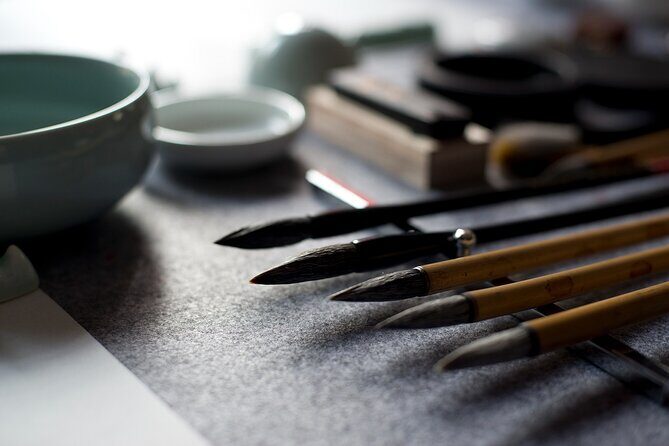
Shanghai can wear you out fast. This workshop is a slower pace. No long lines, no crowded galleries, no racing to the next photo spot. Instead, you sit down in a studio setting and spend two hours focused on brush, ink, paper, and your own chosen character.
What makes it interesting is that you’re not just doing a craft for the sake of it. You get a short introduction to the background of Chinese calligraphy and how people think about this art. Then you apply that in a very practical way: the same writing actions the old masters used, adapted for beginners.
A few more Shanghai tours and experiences worth a look


Where You Start: Yugucun North Gate, Jing’an Area
The class meets at Yugucun (North Gate) in Jing’an District, near Yu Yuan Lu. It ends back at the meeting point, so you don’t have to plan a return trip around your class time.
The key practical point: this is in a local lane area. People have noted that the outside street is one thing, but the house numbers inside the lane are what really matter. If you’re using public transportation, aim to arrive a few minutes early and then follow the provided directions carefully once you’re near the lane.
It’s a good setup for a travel day because it’s close to transit. That matters in Shanghai, where moving across the city can eat time.
Meet Lucie and Settle Into a Small-Group Studio
This workshop is taught by Lucie. Several participants specifically praised her patience and her ability to explain calligraphy basics in a way that makes sense, especially if you’re starting from zero.
The small-group size (up to 8) is one of the best value parts of the experience. When you’re learning brush work, you don’t just need a demo. You need correction—something like how you’re holding the brush, where your wrist should move, and how to keep a stroke smooth instead of wobbling.
The studio atmosphere also gets mentioned positively. You’ll be working in a comfortable indoor space with tea or coffee included, and the whole setup is designed to feel relaxed rather than performance-like.
Chinese Calligraphy 101: History That Makes the Strokes Mean Something
The first portion of the workshop is a brief history of Chinese calligraphy in English. It’s not a lecture that drones on. It’s more like the story you need so the practice doesn’t feel random.
You’ll hear about how Chinese calligraphy developed over time and how people interpret great works of art. You’ll also get interesting context and stories behind what you see in famous pieces—enough that when you later compare your own strokes to examples, you understand what you’re looking at.
This matters because calligraphy isn’t just writing. It’s also timing, rhythm, and control. When you understand the cultural lens a little, your practice gets more focused. You stop thinking, I hope this looks okay, and start thinking, I’m working toward a controlled stroke with the right energy.
Tools and Skills: What You Use (and Why It Feels Different)
After the background, you’ll move into the practical stuff: the tools of Chinese calligraphy. And here’s the big benefit—you don’t have to bring anything. The workshop includes the materials and the instruction.
Chinese brush work can feel counterintuitive at first if you’re used to pens. Ink behaves differently. The brush has its own logic: pressure changes the stroke, angle matters, and your movement has to stay consistent from start to finish. More than one participant described the experience as both mesmerizing and slightly surprising—ink flows quickly, but getting a nice shape in each stroke takes real control.
This is exactly why the guided approach works. You’re not guessing your way through. You’re learning the basic technique steps that make the rest of the session doable.






Warm-Up Practice: Build Control Before You Commit
Warm-up is where beginners often struggle. Too many workshops rush to the final piece. Here, you get practice first.
You’ll drill basic strokes and movements to prepare for the final character. This is more important than it sounds. Calligraphy strokes aren’t isolated. Your final work is the result of how well you connect actions—how you lift, re-place, and flow.
In a class like this, warm-up also gives you confidence. You start seeing what a good stroke looks like, even if yours isn’t perfect yet. And because the group is small, Lucie can help correct the most common issues before they turn into bad habits.
One more practical note: this is hands-on, so expect ink on your work and a few moments of concentrating hard. It’s not complicated, but it is tactile and real.
Your Final Piece: A Folding Fan with Your Chosen Character
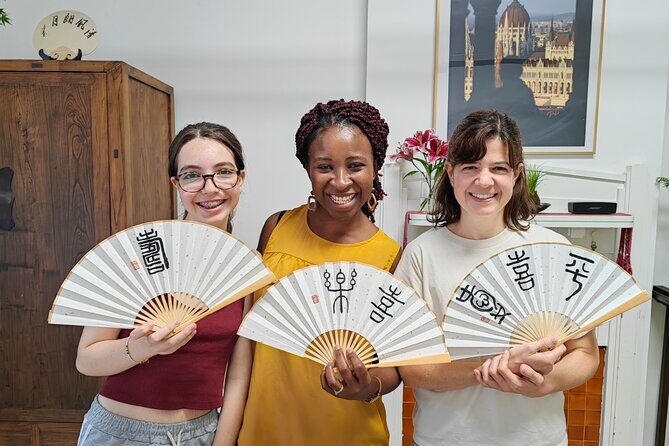
The highlight is the finished souvenir. You’ll create a traditional folding fan decorated with Chinese calligraphy, using a character you select during the class.
That final piece is a smart reward because it’s personal. You’re not just leaving with a generic sample. You’re writing something that matters to you, and you’re doing it using the same kind of approach ancient artisans used—simplified for beginners, but still authentic in feel.
Participants consistently mention pride in the finished fan. Even if your strokes aren’t museum-level perfect, you’ll have something you can show later and explain. It works as a conversation starter, a gift, or just a desk item that reminds you of a quieter side of China.
Value for $50: Why This Feels Fair
The price is $50 per person for about two hours, and the value comes from what’s included.
You get:
- Instruction in English
- All tools and materials
- Tea or coffee
- A small-group experience (max 8)
In practice, the cost is reasonable because you’re paying for teaching and a structured learning session, not just for supplies. You also avoid the common beginner problem: buying materials and still not knowing how to hold the brush or control the ink.
If you’re comparing this to self-guided craft experiences, the difference is guidance. Calligraphy is one of those skills where one tiny correction can improve your results more than an hour of “trying harder.”
If you’re thinking of doing this on a tight Shanghai schedule, the 2-hour format is also a value point. It’s long enough to learn something real and short enough to still enjoy the rest of your day.
Timing Options: Morning, Afternoon, or Evening
You can choose among morning, afternoon, or evening class times. That flexibility is more useful than it seems.
Shanghai days often have a rhythm: you either want a calm indoor activity in the hottest hours, or you want something creative before dinner. This class gives you options so you can match the workshop to your energy level, not your calendar.
If you’re the type who likes solo downtime, the smaller group means you’re not stuck in a massive crowd. Even when the group is small, the pace is set by Lucie, which helps you feel comfortable rather than rushed.
Getting There Without Stress (The Most Common Hiccup)
This is not located right on a major tourist drag. That’s part of the appeal: you’re stepping into a working studio setting, not a shop with a performance.
The practical advice from people who found it easily: follow the directions to the lane carefully and pay attention once you’re inside it. House numbers are marked well, but you’ll want to be precise on the last steps.
If you’re nervous about finding it, plan to arrive early and take your time once you reach the meeting area. You’ll spend two hours learning. You don’t want to spend ten minutes stressed before you start.
Who This Workshop Is Best For (and Who Might Want Something Else)
This workshop is perfect for:
- Beginners who want a clear start with brush basics
- People who enjoy hands-on cultural activities more than museum-style viewing
- Travelers who want a small-group experience without feeling lost
- Anyone who wants a meaningful souvenir made through instruction, not just purchased
It might be less ideal if:
- You want a big sightseeing itinerary or lots of urban wandering
- You dislike quiet, focused activities where you have to pay attention to fine motor control
- You’re only interested in buying art and don’t care about the learning component
Should You Book This Chinese Calligraphy Workshop in Shanghai?
Yes, I’d book it if you want a high-value cultural activity that fits into a normal travel day. You’re getting a structured learning session in English, small-group attention from Lucie, tea or coffee, and a finished folding fan you made yourself.
The main thing to watch is location details. Follow the directions closely around the lane area, show up a few minutes early, and you’ll likely find it smoothly.
If you’re looking for the kind of souvenir that comes with a story, this fits the bill.
FAQ
Is the calligraphy workshop taught in English?
Yes. The workshop is described as being conducted in English.
How long is the Chinese calligraphy class?
It lasts about 2 hours.
What is the group size?
The experience has a maximum of 8 travelers.
What do I get during the workshop?
You get tools and materials, instruction, and tea or coffee.
What will I create at the end?
You will create a traditional folding fan decorated with Chinese calligraphy based on your selected Chinese character.
Do I need to bring my own calligraphy supplies?
No. The class includes all tools and materials.
What times are available to book?
You can choose from morning, afternoon, or evening class times.
Where does the workshop start?
The meeting point is Yugucun (North Gate), in Jing’an District near Yu Yuan Lu, Shanghai (postal code 200040).
Is there mobile ticketing?
Yes, it features a mobile ticket.
What is the cancellation policy?
Free cancellation is offered. You can cancel up to 24 hours in advance for a full refund. If you cancel less than 24 hours before the start time, the amount paid is not refunded.
Are service animals allowed?
Yes, service animals are allowed.