REVIEW · BEIJING
Chinese Kung Fu Experience Class in Beijing
Book on Viator →Operated by Beijing San Feng Tai Chi Club · Bookable on Viator
Kung Fu shows up on film. It feels different in Beijing’s park light, where you practice real basics with a calm, hands-on teacher. I especially liked the Temple of Heaven-area setting and the fact that your instructor can coach you through the movements with clear guidance.
What I loved most was the training structure. You work through stances, punches, kicks, then you build toward a short form and add technique after technique. In the reviews, Master Liu also gets repeatedly praised for being kind and enthusiastic in English, and that matters because it helps you understand what your body is doing.
One thing to consider: this is an introduction, not a full fight-camp. With just about 1 hour 30 minutes, you’ll leave with solid fundamentals and a feel for the movements, but you won’t become combat-ready or learn everything in depth.
In This Review
- Key highlights you’ll notice fast
- Why this Kung Fu class works in Beijing (and not like a gimmick)
- Beijing San Feng Tai Chi Club: the lesson location vibe
- The 90-minute flow: what happens step by step
- 1) Basic Kung Fu training: stances, kicks, punches
- 2) Kung Fu five-stance fist form
- 3) Joint-locking techniques
- 4) Self-defense techniques
- What you’ll learn beyond the moves (the cultural context)
- Price and value: is $65 for 90 minutes worth it?
- Who this class is best for (and who may want something else)
- Practical logistics: making the start smooth
- Should you book this Chinese Kung Fu class?
- FAQ
- FAQ
- How long is the Chinese Kung Fu Experience class?
- Where do I meet for the class?
- Does the activity include hotel pickup or drop-off?
- Is the class private or shared?
- What is included in the price?
- Is the admission ticket included?
- What do I learn during the class?
- Is it suitable for children?
- How physically demanding is it?
- What’s the cancellation policy?
Key highlights you’ll notice fast
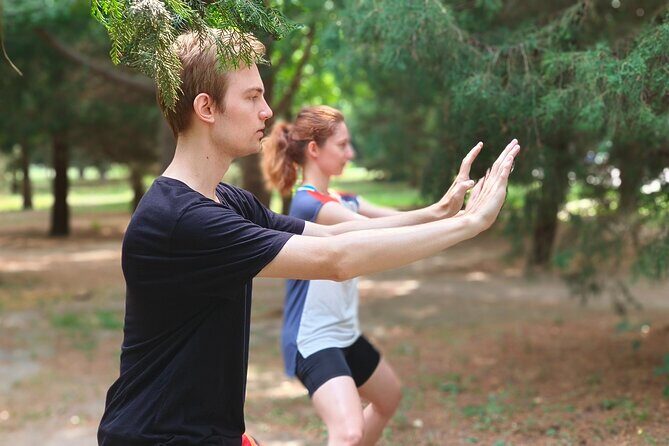
- Instruction in four core skill blocks: basic stances/strikes, the five-stance fist form, joint-locking, and self-defense.
- Master Liu-style coaching: friendly, engaging teaching that keeps kids and adults in step.
- Park-side practice feel: lessons in the shade of trees make the experience easier on the body.
- A tight 90-minute format: enough time to learn and repeat, not so long that you lose the plot.
- Your group only: private setup means the pacing can stay tailored.
Why this Kung Fu class works in Beijing (and not like a gimmick)
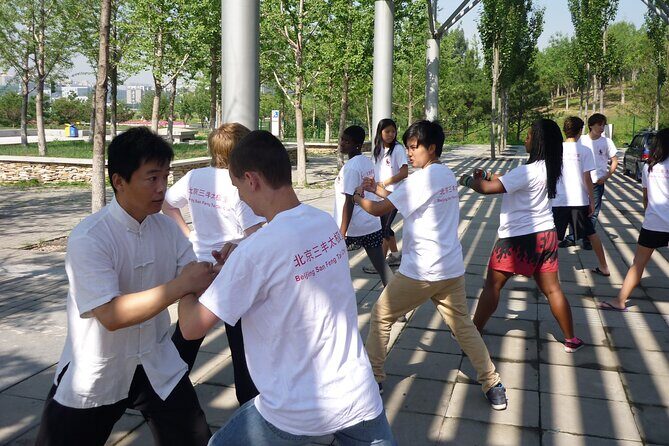
Beijing has plenty of performances you can watch. This one is built for doing—your feet get planted, your arms move, and you learn the logic behind the shapes. The coolest part is the atmosphere: the class takes place near the Temple of Heaven area, so you’re not stuck in a room with mirrors and fluorescent lighting. The reviews describe practicing in the shade, which tells me the teaching is designed to be comfortable and readable, not just ceremonial.
Another reason it works: the instruction isn’t only about flashy movie stuff. In Chinese Kung Fu, there’s usually a bigger goal behind the practice—body control, posture, and a sense of control in motion. This class reflects that better-than-average approach by giving you a structured progression: start with fundamentals, then connect them into a form, then add technique concepts like joint control and simple self-defense.
The private format also changes the vibe. When it’s only your group, you’re more likely to get corrections and explanations that actually fit you. That’s a big deal when you’re learning stances and technique for the first time.
A few more Beijing tours and experiences worth a look


Beijing San Feng Tai Chi Club: the lesson location vibe
Your experience is run by Beijing San Feng Tai Chi Club. The meeting point is at 旻园1, Tian Tan Dong Lu, Dong Cheng Qu, Beijing (100061), and the activity ends back there. That matters because you can treat this like a focused half-day plan: you don’t need a long commute chain, and you’re not stuck figuring out complicated “meet here, then go there” logistics.
The training itself is described as happening inside the Temple of Heaven grounds area, with the group practicing under trees. That gives you two practical benefits:
- You’re in a real public-city environment (so it feels like part of Beijing, not a staged studio).
- The shade and open air can make a 90-minute workout feel more manageable.
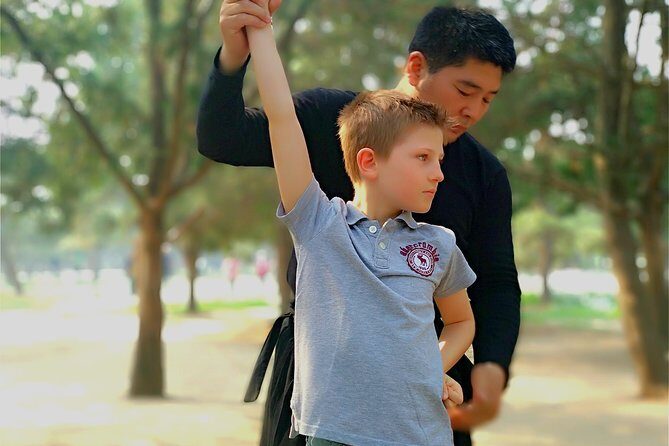
There’s also an important comfort angle. Reviews repeatedly note how engaging the instructor was across ages. In other words, the class seems to be paced with real human attention spans in mind, which helps if you’re traveling with family.
Practical tip: wear movement-friendly clothes and shoes. You’ll be doing stances, kicks, and punch patterns, so you want something that won’t restrict your knees or ankles.
The 90-minute flow: what happens step by step
Even without a long itinerary sheet, the lesson is clearly built like a short training session. You’ll move through the same four skill areas again and again in small chunks, so you can actually remember the shapes by the time you’re done.
1) Basic Kung Fu training: stances, kicks, punches
You start with the foundation: stances plus basic punching and kicking mechanics. This is the segment that helps beginners quickly understand what Kung Fu is asking from your body. The goal isn’t power. It’s alignment, balance, and control—getting your stance stable before you throw a strike pattern.
If you’ve never done martial arts before, stances are where your brain and legs both need time. That’s why this part being early matters. You learn the “language” first, then the rest of the lesson can build on it.
2) Kung Fu five-stance fist form
Next comes the Kung Fu five-stance fist form. Think of this like a short sequence that connects your stances and strikes into one flowing pattern. Forms are useful because they train coordination: you don’t just practice single punches; you practice transitions—how to move from one posture to the next.
In practical terms, this is what makes the experience feel complete. By the end, you’re not walking away with only isolated moves. You’ve got a sequence you can rehearse later.






3) Joint-locking techniques
Then you add a technique layer: joint-locking techniques. This is where the training shifts from “look what I can do” into “control and structure.” Even if the class stays beginner-friendly, joint work usually emphasizes technique over brute force. You learn the idea of leverage and positioning—again, posture and control.
This section is often the part people find most surprising because it’s less about the typical punching-and-kicking visuals and more about how a simple setup can create control. It also helps you understand why Kung Fu is taught as a system, not random moves.
4) Self-defense techniques
You finish with self-defend techniques. The data doesn’t claim you’ll learn full combat readiness, and that’s realistic. For most first-timers, the value of self-defense instruction here is the groundwork: awareness of basic principles, plus a small set of movements you can execute safely and with some understanding.
If you’re looking for a hands-on “starter kit” rather than a fight course, this ending fits well.
What you’ll learn beyond the moves (the cultural context)
The class description frames Kung Fu as more than offense and defense. It’s also connected to moral cultivation, body building, and aesthetic appreciation. That’s not just marketing language. You’ll feel it in the way the class is structured: it starts with posture and controlled shapes, then progresses to sequences and technique.
In plain travel terms, this is the difference between a souvenir workshop and something more meaningful. You’re not only watching or copying. You’re doing a small piece of a traditional training method, which is one of the best ways to understand why Kung Fu remains popular both in China and internationally.
And the teaching style seems to support that cultural learning. Reviews specifically praise Master Liu for being kind, enthusiastic, and able to teach in English. If you’re not fluent in Chinese, an instructor who can explain clearly helps you connect the “why” with the “how.”
Price and value: is $65 for 90 minutes worth it?
At $65 per person, you’re paying for a qualified master, an entrance ticket (noted as included), and a short, structured training session. You’re not paying for a long, multi-stop day or a big production show.
The value comes from three things:
- The time format: about 1 hour 30 minutes is long enough to learn multiple elements, repeat basics, and leave with a sense of progress.
- The instructor quality: “high qualified” is stated in the class info, and reviews back it up with praise for Master Liu’s teaching and English clarity.
- The private-group experience: only your group participates, so the class isn’t diluted across a huge crowd.
A quick caution: one detail in the provided materials says admission ticket not included, while another part lists an entrance ticket as included. To protect your budget, I’d confirm directly whether the ticket covers the specific grounds/entry you need for the session on your date.
Also, group discounts are mentioned. If you have a small group in Beijing already, it can be a smart way to make the lesson cheaper per person than a solo booking.
Who this class is best for (and who may want something else)
This is a great match if you want a hands-on cultural activity that doesn’t require prior martial arts experience. The lesson focuses on basics and short sequences, so beginners can participate without feeling lost.
It also fits families. Reviews explicitly highlight that the instructor kept interest levels high across a wide age range, including kids around 6 to 11. That tells me the coaching is approachable and the pace is manageable.
You might want a different kind of activity if you’re looking for sparring, heavy conditioning, or advanced techniques. This class is built around fundamentals, form practice, and beginner-friendly technique introductions.
If you have moderate physical fitness, you should be fine. The class info asks for a moderate fitness level. That doesn’t mean “athletes only.” It means you should be comfortable moving through stances and basic kicks.
Practical logistics: making the start smooth
No hotel pickup is included, so you’ll plan to get yourself to the meeting point at 旻园1, Tian Tan Dong Lu in Dongcheng. The good news: it’s near public transportation, so you should be able to reach it without a private car.
Bring a simple mindset: this is learning, not performance. If you expect exact movie-perfect moves, you might feel frustrated. If you expect a teacher to guide you through safe, repeatable basics, you’ll enjoy it more.
Timing is also worth respecting. One review notes that Master Liu waited in time in front of the Temple of Heaven area. That implies the meeting process matters, so arrive a little early to reduce stress.
If you’re using the mobile ticket, make sure your phone battery is charged. A small thing, but it prevents last-minute friction in a real-world park setting.
Should you book this Chinese Kung Fu class?
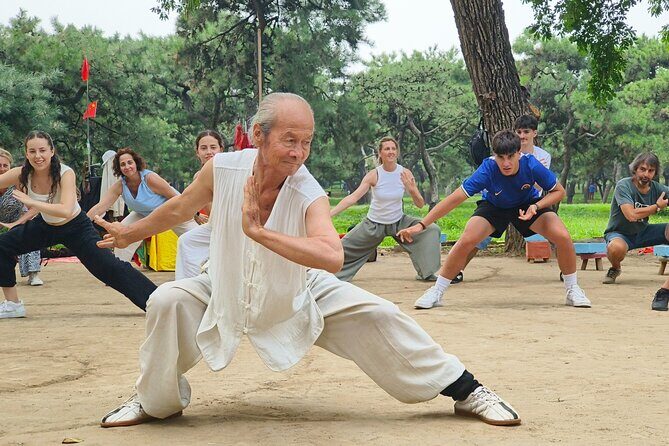
If you want a memorable Beijing experience that’s active, culturally grounded, and taught in a way you can actually understand, I think this is an easy yes. It has strong review support—especially the teaching quality, the fact that it works for both adults and kids, and the location near the Temple of Heaven grounds.
Book it if:
- you’re curious about Chinese Kung Fu but don’t want an overwhelming training commitment
- you want English-friendly coaching (Master Liu is specifically praised)
- you’d enjoy learning a short form and basic technique concepts in one session
- you like activities that feel authentic instead of staged
Skip it or choose something else if:
- you’re mainly interested in advanced martial arts skills and sparring
- you need hotel pickup and door-to-door convenience
- you’re sensitive to the fact that it’s a short introduction (not a long training program)
FAQ
FAQ
How long is the Chinese Kung Fu Experience class?
The class is about 1 hour 30 minutes.
Where do I meet for the class?
The meeting point is 旻园1 Tian Tan Dong Lu, Dong Cheng Qu, Bei Jing Shi, China, 100061.
Does the activity include hotel pickup or drop-off?
No. Hotel pickup and drop-off is not included.
Is the class private or shared?
It is listed as private, and only your group will participate.
What is included in the price?
The included items are a high qualified Kung Fu master and an entrance ticket.
Is the admission ticket included?
One part of the provided details mentions an entrance ticket as included, while another line says admission ticket not included. I recommend confirming with the provider for your exact date.
What do I learn during the class?
You’ll learn basic training such as stances, kicks, and punches, a Kung Fu five-stance fist form, joint-locking techniques, and self-defend techniques.
Is it suitable for children?
Children must be accompanied by an adult, and the class has been described as working well for a range of ages.
How physically demanding is it?
You should have a moderate physical fitness level, since the class includes stances, kicks, and technique practice.
What’s the cancellation policy?
Free cancellation is available up to 24 hours in advance for a full refund.
If you want, tell me your travel dates and group size (adults/kids), and I can help you think through whether the timing and private setup fit your Beijing plan.